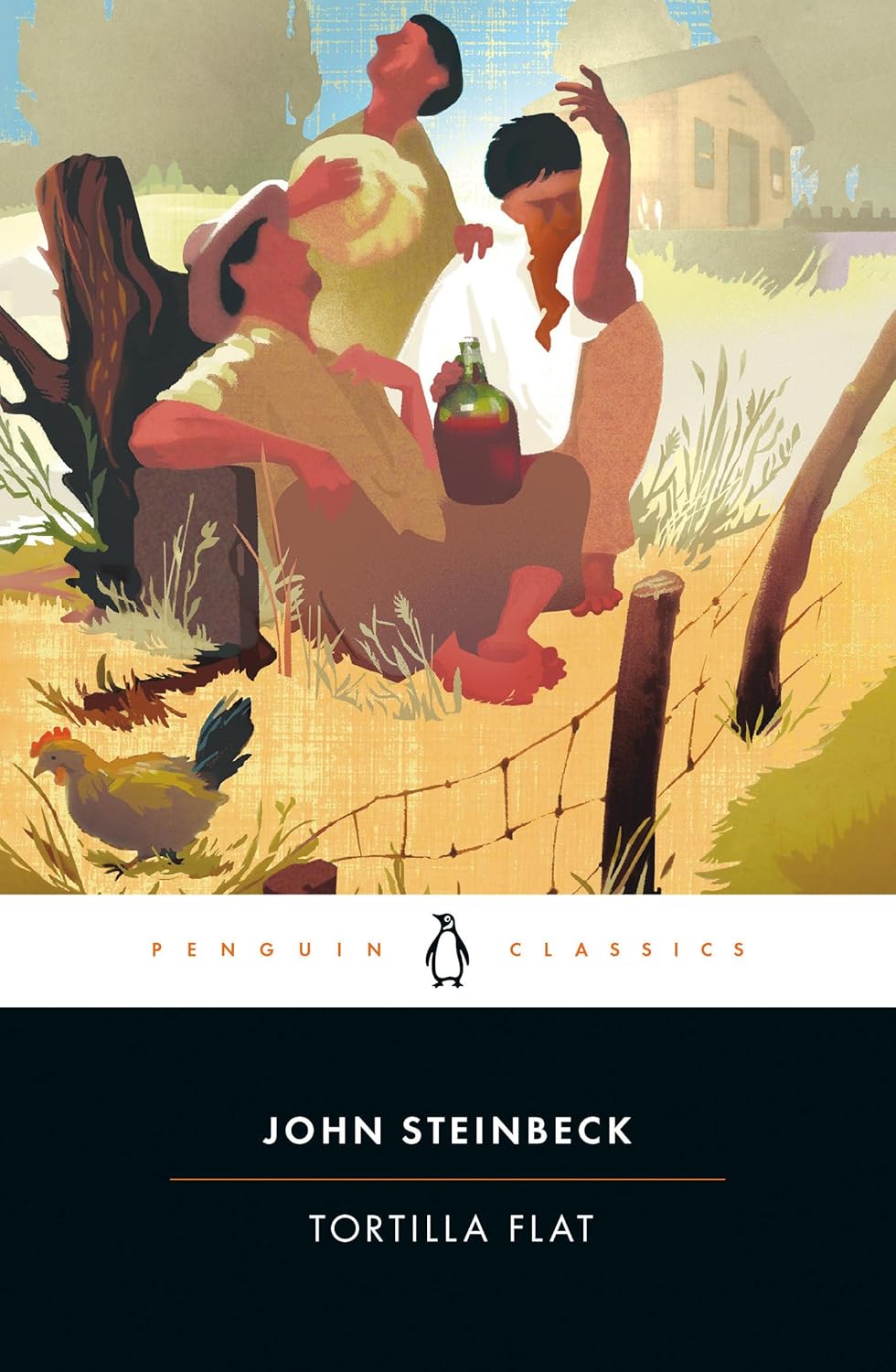
Pound for pound, this is one of the best books I have read this year. It also launched one of my favorite literary data collection projects yet: a complete accounting of the flow of finances between characters, built by compiling a 314-row audited journal of transactions.
Takeaways
- The novel has an openly Arthurian structure, with Danny’s house serving as an ersatz Camelot, but I think the better comparison from the chivalric tradition in terms of the novel’s style and tone is Don Quixote. Perhaps this is a bias of the Spanish language influence on the dialogue, but I think the humor, specifically, surpasses anything in the Arthurian canon and shares a wry, slightly cynical quality with Quixote.
- The work says so much about Steinbeck as a creator that, even as a heavy reader of his work, I found it revelatory. First, it shows how uniquely generative he was. Tortilla Flat‘s 17 chapters do cohere into a broader narrative, but as in Don Quixote, each of them is self-sufficient enough to be called an entertaining vignette. The quality is high and even across all chapters, a fact that continually surprised me in my reading.
- Second, we see the stylistic evolution of Steinbeck. The stories each lack more than a paragraph or two of the cinematic, detailed descriptions that would become hallmarks of his later work. And while collectively the characters are some of Steinbeck’s most charming, they are not individually much at all. All except for Pilon lack a certain interiority that would suffuse his later characters like Adam Trask and Ethan Hawley.
- Speaking of characters, we get some interesting prototypes in this early work. Torrelli, the enterprising, bootlegging owner of the retail center of Tortilla Flat commerce, is a sort of early sketch of Marullo the grocer in The Winter of Our Discontent. Same goes for Danny himself, whose connection with Discontent‘s Danny Taylor seems undeniable.
- Despite some of the trickery and adult themes, the stories would make excellent bedtime stories for kids, giving the work a quality that makes it feel more like a book of fables than a novel. As the character Pilon points out, “‘Things that happen are of no importance […] but from everything that happens, there is a lesson to be learned’” (91).
- The stories are an honest and charming portrayal of community. In reviewing the transactions in the novel, I was impressed to find that the data align closely with what can be intuitively grasped in the story: the paisanos live as a collective. Debt is cheap despite credit being exceptionally poor. Out of 33 debts and promises in the book, only one is paid in full, and it is owed to a saint. Yet the community functions primarily because so many of the defaults are offset by sharing. It is a strange and thievish community aid network, but it is a strong one nevertheless (most notably, in the way the town rallied around Teresina Cortez and her family following the ruined bean crop). What balances the ledger is social currency, and the paisanos are rich with it. For those interested in the financial side of the book, see the Accounting Coda below.
- It has maybe the best, most satisfying ending of any novel (no spoilers in this bullet). As I pointed out, the chapters do cohere into a larger plot, and Steinbeck chooses the perfect resolution. This phenomenon is so rare in writing that it merits a specific callout each time it happens. Page 1 of the book warns that we will be left with “in the end, a mystic sorrow,” and the ending delivers exactly that. Bravo.
Rating: 9/10. One of the more “recommendable” books I’ve read in years, and I am certain I will revisit it at some point.
Accounting Coda (spoilers ahead)
Letting loose my inner accounting nerd, I worked with Claude Opus 5.5 to map every transaction in the book: every dollar, gallon of wine, stolen blanket and unpaid debt. Once I had the data, I couldn’t resist going all the way and producing a set of audited financial statements for “Danny and Friends Co.” They come complete with an auditor’s report, footnotes, a schedule breaking out each member’s results, and a management representation letter signed by Pilon. The working papers are here too: all 314 transactions, for anyone (human or AI) who wants to check the work.
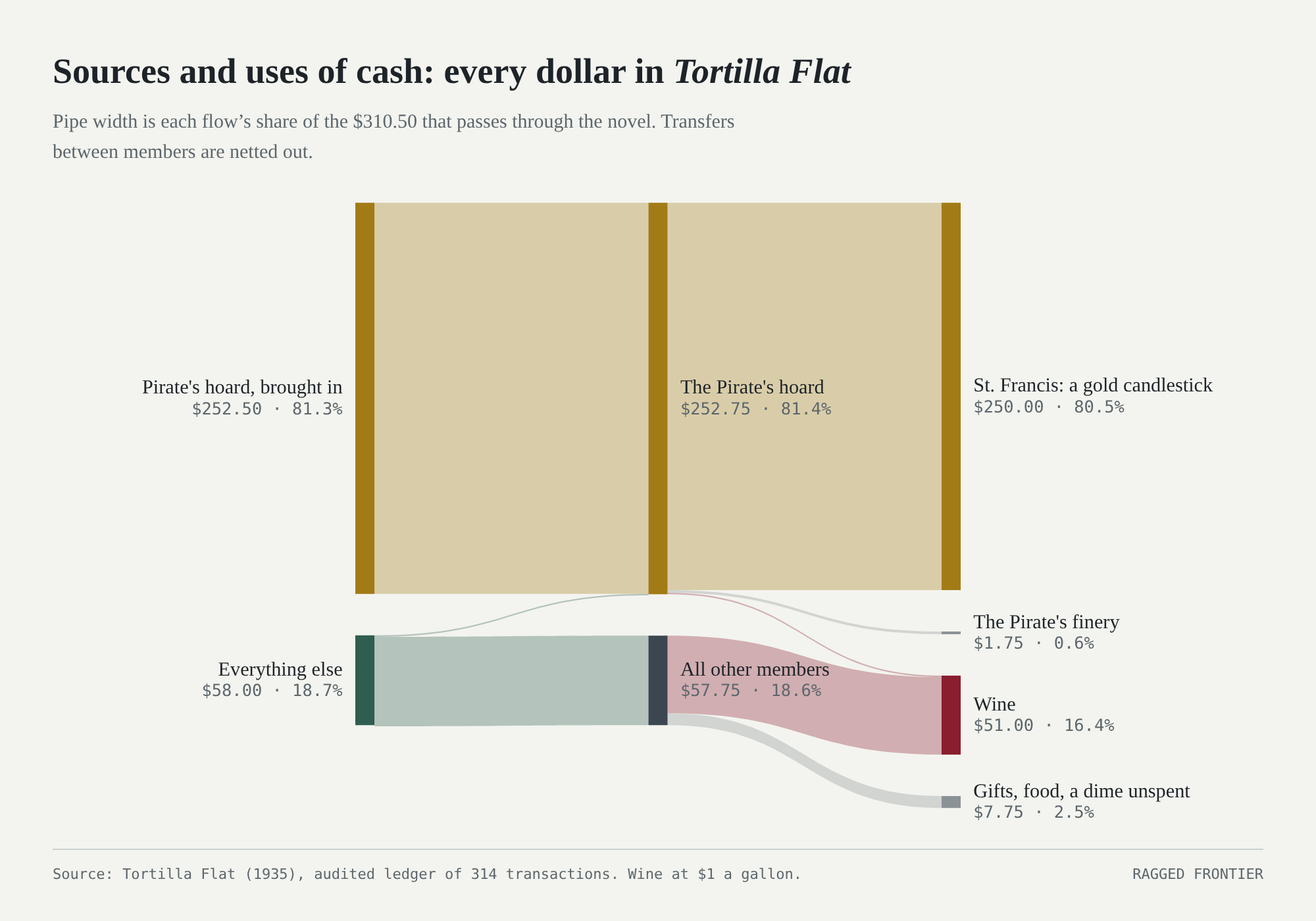
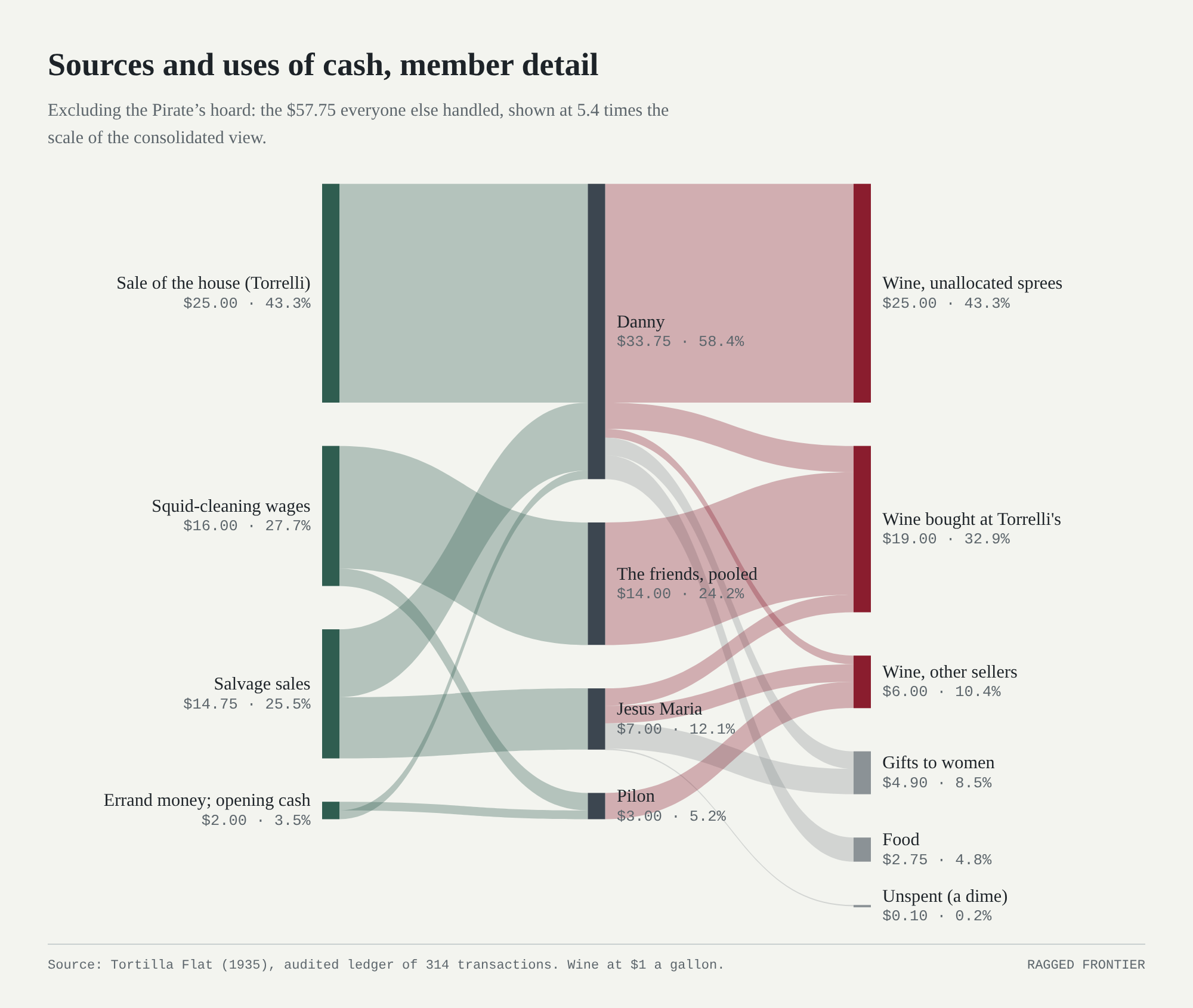
The chart below shows where the cash goes. Of the $310.50 that changes hands in the novel, 81% is the Pirate’s sack of quarters, and nearly all of it ends up as a gold candlestick for St. Francis. Everyone else gets by on $57.75 over the whole book, most of it spent on wine the same day it arrives. Which is sort of the point: there’s barely any money in Tortilla Flat, so whatever holds the paisanos together, it isn’t cash.


Leave a Reply